

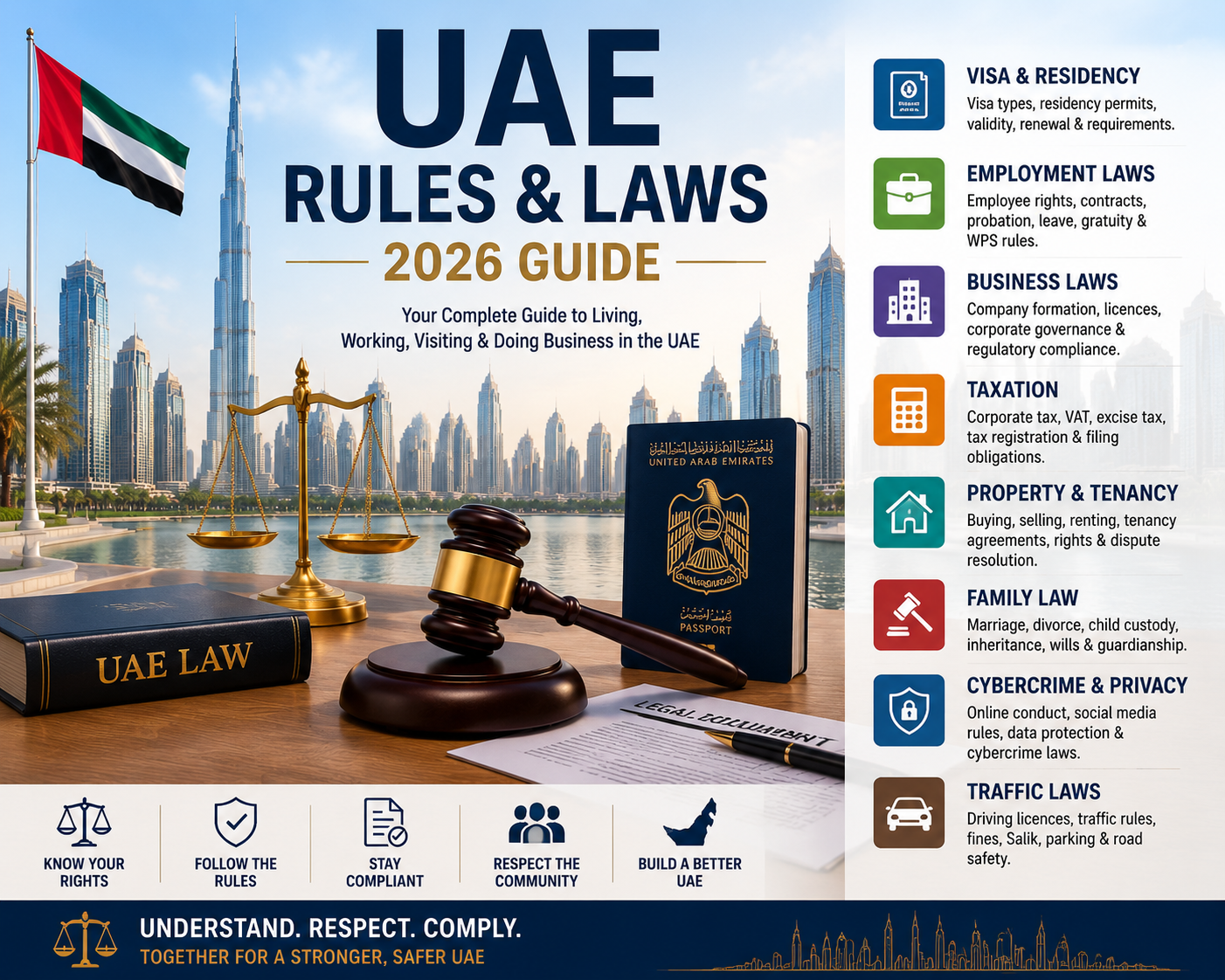
Life in the UAE provides an endless field of opportunities, but the responsibilities placed on each person living here are fully supported by law. Traffic decisions, a business licence, a tenancy agreement, an employment contract, or even what you post on social media may have repercussions if you are not aware of the rules governing them.
UAE rules and laws include immigration, employment, contracts, business, taxation, traffic, online conduct, property matters, family-related issues, and public safety. Many areas are governed by federal laws while others can be set locally. Check which legal framework applies to your case at all times: residents, visitors, employees, and businesses. As its economy, technology, and population develop, the UAE enjoys regular acts of legislation to keep up with these changes.
How Does the UAE Legal System Work?
Once you understand the legal framework, it is easier to navigate all other UAE rules.
The United Arab Emirates (UAE) consists of a federation of seven emirates. Its legal framework consists of federal laws and local legislation enacted pursuant to the constitutional authority of each emirate. The legal system of the UAE is composed of local courts in some emirates and the Federal Judiciary.
This means there could be a federal law that is applicable all over the UAE that differs in areas such as procedures, property regime, transportation infrastructure, or even licensing policies in Dubai, Abu Dhabi, Sharjah, etc.
Federal Laws vs Local Regulations
Consider the system as two transparent layers.
The federal dimension includes national issues such as employment, criminal justice, corporate taxation, cybercrime, immigration, and commercial law.
The local layer refers to issues within an emirate’s jurisdiction or that need management at the local level.
| Legal Area | Typical Level | Example |
| Employment | Federal | Private-sector labour rules |
| Immigration | Federal | Residence and entry permits |
| Cybercrime | Federal | Online offences and digital safety |
| Corporate tax | Federal | Business taxation |
| Property | Federal+ local | Contract law plus emirate property rules |
| Parking/tolls | Local | Emirate-specific transport systems |
| Business licensing | Federal + local/free-zone | Activity and licensing requirements |
What Changed in UAE Laws in 2026?
Several developments are particularly worth noting this year.
Civil Adulthood Is Now 18
The new Civil Transactions Law in the United Arab Emirates (UAE) brings the age of majority down from the previous level to 18 Gregorian years. By official law, the date of a person’s age of majority is when they have completed 18 Gregorian years.
An 18-year-old can then be more independent in entering into civil contracts and other personal matters. This does not apply to all regulated activities, as not all become available at 18. There may be age or eligibility restrictions, or specific activities may have specific licensure requirements.
Social Media Minimum Age Introduced
One of the most important events in 2026 will concern children’s digital security. Under the framework that governs children’s access to social media platforms, the minimum age of social media usage is 15 years, as provided in Cabinet Resolution No. 106 of 2026.
This will have a special impact on digital platforms, advertisers, technology firms, schools, and parents.
5% VAT on UAE Toll Transactions
The UAE Government has officially issued guidelines for the roadways industry, and it states that a 5% VAT will be applied to toll transactions from 1st June 2026.
It might seem like a small amount for a single journey, but regular commuters and businesses with vehicle fleets need to consider this when factoring transport costs.
What Does UAE Labour Law Mean for Employees and Employers?
One of the biggest implications of mistakes in UAE rules and laws concerns employment as salary, visas, benefits, notice period, and business liability can all be affected.
The majority of employment relationships in the UAE private sector are governed by Federal Decree-Law No. 33 of 2021 and its associated regulations.
Probation Cannot Continue Indefinitely
In the private sector, six months is the longest probation. Employees and employers need to be careful with contract dates as probation alters particular notice and employment obligations.
Salaries and the Wages Protection System
Under the WPS, private-sector employers subject to the system are required to pay employees. Failure to comply will subject U.S. employers to both monetary and regulatory sanctions.
Leave Entitlements
For private sector workers, you may receive the following based on eligibility and circumstances:
- Annual leave
- Sick leave
- Maternity leave
- Parental leave
- Bereavement leave
- Official holidays
All eligible private-sector workers are entitled to five working days of parental leave, to be taken within six months of the birth of a child.
What Are the Rules for UAE Social Media and Cybercrime?
In the UAE, Online behaviour is no different from offline behaviour, and it requires equal care.
Federal Decree-Law No. 34 of 2021 on Combating Rumours and Cybercrimes provides a wide legal framework that regulates cyber offences and misuse of information technology or smart electronic services.
Legal Risk Activities
Be cautious before:
- publishing someone’s private information
- Reproducing private photographs without proper authority
- making defamatory allegations online
- impersonating another person
- gaining unauthorized access to accounts or systems
- spreading false or illegal online content
- reposting without checking what it contains.
What Traffic Rules Should Drivers Know in the UAE?
There are tough road rules, and drivers are expected to know the current rules, not what they were a few years ago. To meet the general statutory age condition for the issuance of a driving licence, a person has to have reached 17 Gregorian years.
Drivers should periodically review the following rules:
- Speed limits
- Valid driving licences
- Vehicle registration
- Motor insurance
- Seat belts
- Mobile-phone use
- Lane discipline
- Reckless driving
- Parking
- Tolls
- Other vehicles
What Property and Tenancy Laws Apply in the UAE?
Emirate-specific property registration, tenancy, and dispute processes and systems may apply to property transactions and to federal contract principles.
Before buying or leasing property, review:
- Ownership records
- Tenancy or sales contract
- Payment obligations
- Service charges
- Maintenance responsibilities
- Notice periods
- Renewal terms
- Termination clauses
- Dispute-resolution provisions
What Family Laws Apply in the UAE?
Family status and personal status issues are sensitive and must be addressed with special attention, as the law surrounding these situations can differ based on individuals and circumstances.
The UAE’s current laws on marriage and divorce are set out in the Federal Decree-Law No. 41 of 2024 on the Personal Status Law. The UAE also has civil personal status laws that apply to non-Muslims, such as marriage, divorce, inheritance, and custody.
Family-law matters may involve:
- Marriage
- Divorce
- Maintenance
- Custody
- Guardianship
- Inheritance
- Wills
Matters involving individuals, marriages, children, or property that span multiple jurisdictions can be complex. In cross-border situations, it is important to receive legal counsel specific to the situation.
How Can You Stay Compliant With UAE Laws?
No one wants to be a resident or business owner who tries to remember all of the statutes.
Use These Seven Habits
Verify rules through official sources
Begin at the UAE Legislation Portal and the UAE Government Portal.
Read contracts before signing
Existence of long-term obligations through employment, property, partnership, and supplier agreements.
Monitor expiry dates
Monitor visas, Emirates ID, Business Licences and Permits, Insurance and Registrations.
Keep records
Keep contracts, payment receipts, notices, approvals and other key correspondence.
Check local requirements
In matters that involve local government, federal law is just one of the issues.
Check compliance of businesses regularly
There may be regulatory changes to the requirements for taxes, employment, AML, licensing and privacy.
Seek qualified advice for high-value decisions
These vary and require careful legal review, including: property transactions, legal actions, business problems, employment issues and complicated family matters.
These are practices equivalent to car maintenance. It is much simpler to troubleshoot problems at regular intervals than when they occur.
FAQs
What are the most important laws to know in the UAE?
Residents and visitors to the UAE should familiarize themselves with visa, employment, cybercrime, privacy, traffic, contract, prohibited goods, property and family laws. Other areas of interest for businesses include licensing, corporate tax, VAT, data protection, employment compliance and industry-specific regulations.
Are UAE laws the same in all seven emirates?
No. There are many laws in the UAE that are applicable throughout the UAE, but emirates may also have local laws, authorities, and judicial procedures.
What is the legal age of adulthood in the UAE in 2026?
Under the UAE’s new Civil Transactions Law, an individual reaches the age of majority in Gregorian terms. There may be specific minimum age or eligibility requirements for specific regulated activities.
Can you legally work in the UAE without the correct employment permit?
Foreign workers need to complete the required legal employment and immigration procedures before they start working. For private sector jobs, regulations are based on the UAE Labour Law and the work permit process.
Are social media posts regulated in the UAE?
Yes. Online activities such as cyber offences, misuse of digital systems, privacy violations, and unlawful content may be subject to the UAE’s cybercrime, privacy, and media laws.
Conclusion
Learning UAE rules and laws is not about the memorisation of law but about knowing which rules impact your decision. From signing employment contracts to renewing visas, establishing a business, buying property, driving, posting online, to handling a family matter, a little compliance attention can save a lot of trouble.
The UAE’s legal landscape is still evolving. Comprehensive information is important for the 2026 Civil Transactions reforms, children’s digital safety rules, tax and employment protection, and changing business legislation.
As a rule, government legislation should be consulted as a primary source of information. If you are dealing with substantial monetary affairs, business obligations, immigration or employment rights, property, or a legal dispute, seek advice based on your situation.
Looking for guidance on how UAE rules and laws apply to your situation and/or business? For practical advice on legal, business, and compliance issues in the UAE, contact The ASK Consultancy.

