

Dubai offers exceptional opportunities for professionals, students, and expats seeking employment and a modern lifestyle. However, before relocating, understanding living costs—including housing, food, transport, healthcare, and education—is essential. Your total monthly expenses in 2026 will vary significantly based on your lifestyle, location, family size, and job benefits, all detailed in our Dubai Lifestyle Guide 2026: Everything You Need to Know Before Moving to Dubai.
For example, a single individual living in a shared apartment and relying on public Metro transport can manage comfortably on a modest income. Conversely, a family renting a spacious apartment, managing tuition fees, and running a personal car will require a substantially higher budget.
What Is the Average Cost of Living in Dubai in 2026?
Average expenses are greatly influenced by whether an individual lives alone, shares a place, or even supports a family. The biggest expense will be the rent, followed by education, transportation, and utilities. Below are budget estimates in UAE Dirhams (AED) only. Costs can vary greatly from one property to another, as well as from individual to individual.
Estimated monthly living costs

These ranges are useful starting points rather than fixed budgets. In particular, premium housing, private schooling, frequent restaurant visits and car ownership can push monthly spending well above these estimates.
Accommodation Costs in Dubai in 2026
Accommodation is normally the largest part of the cost of living in Dubai. While the luxury apartments abound in some neighborhoods, there are cheaper alternatives to be found in residential neighborhoods which are further away from the commercial areas.

Average Monthly Rent in Dubai
The following numbers are just general estimates for average long-term accommodation costs. Rentals and signed leases may vary a great deal, depending on various factors.
| Accommodation type | Estimated monthly equivalent |
| Bed space in shared accommodation | AED 600–1,500 |
| Private room in a shared apartment | AED 1,500–3,500 |
| Studio apartment | AED 3,000–6,000 |
| One-bedroom apartment | AED 4,500–9,000 |
| Two-bedroom apartment | AED 6,500–14,000 |
| Three-bedroom apartment | AED 9,000–22,000+ |
Annual rent payments are usually made by means of one or more cheques instead of being paid monthly. The following figures are equivalent to the monthly rent payments but do not necessarily mean that the owner accepts monthly payments.
Affordable areas to rent in Dubai
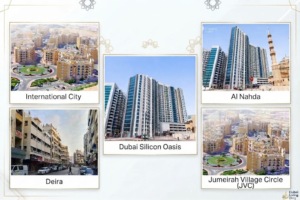
International City
A choice for those on a budget looking for reasonably priced apartments. Nevertheless, commuting may take time if you work in the heart of Dubai.
Al Nahda
Favoured by both families and workers looking for an affordable living place in proximity to all necessary amenities.
Deira
Features well-established communities, local bazaars, eateries, and public transportation facilities at many locations.
Dubai Silicon Oasis
A good choice for professionals and families who prefer to live in a planned community complete with shopping and other amenities.
Jumeirah Village Circle (JVC)
Features a variety of apartments and houses suitable for a family. Transport accessibility must be confirmed before opting to rent here.
Premium areas and their rental costs
Dubai Marina, Downtown Dubai, Palm Jumeirah and Business Bay areas appeal to residents with a preference for waterfront locations, prime locations, modern buildings and entertainment facilities.
However, it can cost more to live in these areas compared to living in the outer residential neighborhoods. So, take into account the overall cost of housing and travel time, not just the rent price.
Extra housing costs
There are other costs besides paying rent for your housing in Dubai. You should also consider such costs as:
- Security Deposit: typically 5% of annual rent for an unfurnished apartment, with various possibilities for a furnished one.
- Agency Commission: usually 5% of annual rent, depending on the deal.
- DEWA connection and Deposit: connection costs and deposit for electricity and water may exist.
- Registration of Ejari: fee for tenancy contract registration.
- Initial Internet Setup and Furniture Costs: additional costs for moving.
Do not forget to know the current prices, payment period, and renewal procedure before you sign the lease agreement.
Grocery and Food Costs in Dubai
The cost of food is dependent on the market where one buys their groceries, frequency of cooking, and preference for foreign goods or local options. Luckily, Dubai boasts various supermarkets, traditional markets, discount shops, and affordable restaurants for everyone’s financial capabilities.

Average monthly grocery expenses
| Household type | Estimated monthly cost |
| Single person | AED 700–1,200 |
| Couple | AED 1,300–2,200 |
| Family of four | AED 2,200–4,000 |
| Family buying premium products | AED 4,000–6,000+ |
These estimates cover groceries for home cooking. Frequent restaurant meals, food delivery, and premium imported items will increase the total.
Typical grocery prices in Dubai
| Grocery item | Estimated price |
| Milk, 1 litre | AED 6–9 |
| Bread, one loaf | AED 4–8 |
| Eggs, 12 | AED 9–16 |
| Rice, 1 kg | AED 6–14 |
| Chicken, 1 kg | AED 20–35 |
| Apples, 1 kg | AED 6–12 |
| Bananas, 1 kg | AED 5–9 |
| Potatoes, 1 kg | AED 3–7 |
| Bottled water, 1.5 litres | AED 1.50–3 |
Prices are indicative estimates, not verified prices for every supermarket in October 2026. Brands, promotions, and product origins can affect the final bill.
Where can you buy affordable groceries?
- Lulu Hypermarket: A useful store for purchasing in large quantities, general groceries, and South Indian foods, complementing other bargain options listed in our guide on Cheap Shopping in Dubai: Best Budget Shopping Places & Markets.
- Carrefour: Offers different varieties of fresh food, packaged foods, and home needs.
- Nesto: Useful for discounted purchases and family grocery shopping.
- Union Coop: Provides groceries and home needs throughout Dubai.
- Fruit and vegetable vendors: They could be offering lower prices for their seasonal products.
Restaurant and takeaway expenses

The food in Dubai ranges from cheap restaurants to expensive ones. As such, your budget for food will greatly vary according to how often you eat out.
| Dining option | Approximate cost per person |
| Budget cafeteria meal | AED 15–30 |
| Casual restaurant meal | AED 30–70 |
| Mid-range restaurant meal | AED 70–150 |
| Fine dining | AED 200–500+ |
| Coffee from a cafe | AED 12–25 |
According to a table, spending on inexpensive meals outdoors during weekdays in a month may range between AED 300 and 650 based on the cost per meal and number of weeks. You can be able to save money by cooking your own meals and making fewer food deliveries.
Transportation Costs in Dubai
Transport is relatively easy if you are near the Metro and a reliable bus service. However, people living far away and those who drive to work will have to budget for fuel, parking space, and insurance costs.
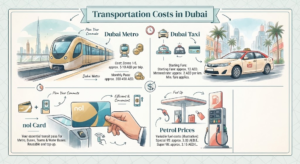
Costs of Dubai Metro and bus
The transportation system in Dubai includes the Metro, buses, trams, and marine transport. Most passengers travel using the Nol card.
| Transport option | Estimated cost |
| Standard public transport journey | AED 3–7.50, depending on zones and journey |
| Monthly transport budget for a regular commuter | AED 250–500 |
| Taxi starting fare | Varies by service, time, and booking method |
| Occasional taxi or ride-hailing budget | AED 200–700+ per month |
The cost of public transport tickets is based on the number of zones, card type, and mode of transportation used. There are varying prices and requirements for monthly travel passes, and one should review the latest RTA fare schedule before buying.
Monthly cost of owning a car
Car ownership may be quite convenient, especially for those who live at a considerable distance from Metro stations. However, the expenses involved go far beyond gas.
| Expense | Estimated monthly budget |
| Fuel | AED 250–700 |
| Parking | AED 100–500+ |
| Insurance, averaged monthly | AED 150–400+ |
| Maintenance and servicing allowance | AED 100–300+ |
| Salik tolls | AED 50–250+ |
These costs are merely illustrative and do not take into account the payment for loans, depreciation, and significant repairs. Your costs would be different, depending on the car, distance traveled, insurance, and parking.
How to reduce transport costs
- Live close to your workplace or to metro stations, where you can.
- Have a Nol card and see if there is any travel card available that would help you save on your commute expenses.
- Check how much it costs to drive and how much to use public transport before you buy the car.
- Go for a walk if the distance is short enough.
- Consider carpooling with other co-workers if possible.
The last thing worth mentioning is that living in the cheapest place may not necessarily be the most economical solution if your daily commute costs a lot.
Electricity, Water, Cooling and Internet Bills
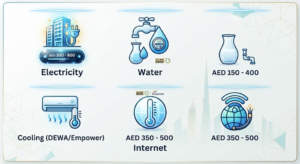
Another factor contributing to the cost of living in Dubai is utility charges. The use of air conditioners may increase power consumption in the summer season due to the heat.
Estimated monthly utility expenses
| Expense | Single person or small apartment | Family home |
| Electricity and water | AED 250–600 | AED 500–1,200+ |
| Cooling charges, if separate | AED 0–400+ | AED 0–800+ |
| Home internet | AED 250–450 | AED 250–450 |
| Mobile phone plan | AED 50–200 | AED 100–400 for multiple lines |
These are just estimates; the electricity and water usage may not include the cost of cooling, which is separate. You will find your charges based on your usage, building condition, size of the apartment, and telecoms.
What is DEWA?
- Dubai Electricity and Water Authority
- DEWA offers electricity and water services to many places in Dubai. The tenants should confirm the services provided, including connection charges, costs for the property, and monthly bills.
- It is important to ask whether the air conditioning service has been included in the rent or not. Often, there is an arrangement for cooling in some buildings.
Internet and mobile expenses
There are two main telecom service providers operating in Dubai: e& UAE and du. These companies provide mobile and internet services at various prices. To manage your costs:
- Compare prepaid and postpaid mobile services.
- Do not pay for data packs that you hardly use.
- Check installation fees and other conditions before choosing home internet service.
- Evaluate promotional offers carefully.
Healthcare and Health Insurance Costs
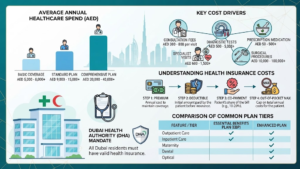
Healthcare is one of the major aspects that people should consider when settling in Dubai. It is crucial that residents understand the nature of their health insurance to budget for visits to the doctor. There are both public and private healthcare facilities available in Dubai, which include clinics, specialist centers, and hospitals. The cost of treatment is based on your insurance.
Estimated healthcare expenses
| Healthcare expense | Indicative cost |
| General practitioner consultation | AED 150–400 |
| Specialist consultation | AED 250–700+ |
| Basic prescription medicines | AED 20–200+, depending on medicine |
| Individual insurance premium | Varies widely by age, coverage and insurer |
| Family insurance | Depends on family size, benefits and exclusions |
These represent indicative planning costs, and not official rates.
Health insurance in Dubai – is it compulsory?
There are compulsory health insurance requirements in Dubai, fully detailed in our UAE Health Insurance Guide 2026: Rules, Costs, Coverage & How to Choose the Right Plan. The responsibility lies mainly with the employers, who are supposed to insure employees, while dependents may be insured in accordance with the rules and employment packages. Thus, before you accept an employment offer, make sure:
- Whether the employer offers health insurance.
- Whether there is medical insurance for the dependents.
- A list of hospitals and clinics that are within the plan.
- Covering dental care, maternity care, and prescription medicines.
- All the deductibles, co-payments, and exceptions.
Therefore, employer-provided insurance will help significantly to reduce your cost of living.
School Fees and Childcare Costs in Dubai
Families who have kids ought to consider their educational costs prior to deciding on the salary they would require in Dubai. Costs vary based on the kind of curriculum, level, and school prestige and facilities.

Dubai provides various types of curricula like British, American, Indian, IB, and many more. While there are inexpensive schools, the expensive international schools may cost a pretty penny.
Average school fees in Dubai
| Education expense | Estimated cost |
| Nursery or preschool | AED 1,500–4,000 per month |
| Affordable private school | AED 5,000–15,000 per year |
| Mid-range private school | AED 15,000–40,000 per year |
| Premium international school | AED 40,000–100,000+ per year |
| School bus | AED 300–900 per month |
| Books, uniforms and supplies | AED 1,000–4,000+ per year |
This range is for illustration only and does not indicate the cost of attendance of any particular school. Costs will vary depending on the age and grade level of the child and other factors.
Other educational costs to consider
Besides tuition costs, there could be other costs of educating a child like registration, transport, uniforms, feeding, extracurricular activities, and educational materials. It is therefore important that you always check the current fee schedule at the school and find out if your employer offers an education allowance.
Entertainment, Shopping and Fitness Expenses
Dubai provides an extensive list of entertainment facilities such as public beaches and parks, shopping malls, movie theaters, gyms, and much more. Due to this, you will have the ability to entertain yourself on a minimum budget or by spending a little more on entertainment.

Typical leisure expenses
| Activity | Estimated cost |
| Cinema ticket | AED 35–65 |
| Standard gym membership | AED 150–400 per month |
| Premium gym membership | AED 400–900+ per month |
| Casual social outing | AED 50–150 per person |
| Paid tourist attraction | AED 50–300+ per person |
| Shopping and personal care | AED 200–800+ per month |
Actual prices vary by venue, season, membership plan, and promotional offer.
Free and affordable things to do in Dubai

Public beaches
You have the chance to go walking and relaxing near the waterfront without having to pay to get access to these places.
Dubai Marina Walk
Have a great chance to spend time with a view of the waterfront and do some exercise. Spending money is optional here except if you decide to eat somewhere.
Spending time in public parks
Parks can be an inexpensive option when it comes to doing some jogging or walking, but sometimes you may have to pay something extra.
Old Dubai
This place offers you the chance to explore historic neighborhoods and traditional markets. Traditional boat rides can be a cheap option for exploring Dubai Creek.
With a combination of outdoor activities and sometimes paid entertainment, residents can have fun in Dubai while keeping entertainment costs low.
Taxes and Other Living Expenses in Dubai
A major reason why Dubai attracts many professionals from overseas is that the UAE does not have any personal income tax on employees’ salaries. However, residents will have to pay for different consumption and service taxes.
Key costs to note
- VAT: The standard VAT rate in the UAE is 5% for most taxable products and services under relevant legislation.
- Housing charges: Different municipal or housing charges may be applicable based on your tenancy status.
- Transportation costs: Registration fees, testing costs, insurance costs, toll charges, and parking costs may add up to your transportation costs.
- Banking and remittance costs: Bank account fees and foreign transactions may reduce the amount that you transfer home.
- Travel: Return airfares, dependent visa costs, and holiday breaks are all part of the relocation costs.
Although the lack of income tax in some cases may increase one’s disposable income, it is not the end-all factor that determines whether Dubai is cheap or not.
Monthly Budget Examples for Different Lifestyles

The following examples show how your expenses might look under different circumstances. They are sample budgets, not predictions of what every resident will spend.
Budget A: Single professional sharing accommodation
| Expense | Monthly budget |
| Shared accommodation | AED 1,500 |
| Groceries and basic meals | AED 900 |
| Public transport | AED 300 |
| Utilities and internet contribution | AED 250 |
| Mobile phone | AED 100 |
| Personal care and entertainment | AED 450 |
| Miscellaneous expenses | AED 300 |
| Total | AED 3,800 |
This budget assumes shared housing, limited restaurant spending, and no car. It excludes major medical expenses, remittances, debt repayments, and significant savings goals.
Budget B: Single professional living independently
| Expense | Monthly budget |
| Studio or modest apartment | AED 4,500 |
| Groceries and dining | AED 1,200 |
| Transport | AED 400 |
| Electricity, water, and cooling | AED 500 |
| Internet and mobile | AED 350 |
| Entertainment and fitness | AED 500 |
| Miscellaneous expenses | AED 400 |
| Total | AED 7,850 |
This example represents a relatively controlled lifestyle. A central location, a premium apartment, or frequent dining out could push the total much higher.
Budget C: Couple without children
| Expense | Monthly budget |
| One-bedroom apartment | AED 6,000 |
| Groceries and dining | AED 2,000 |
| Transport | AED 800 |
| Utilities and internet | AED 800 |
| Mobile phones | AED 250 |
| Leisure and personal expenses | AED 1,000 |
| Miscellaneous expenses | AED 500 |
| Total | AED 11,350 |
This assumes a shared household and a mix of home cooking and restaurant meals. Car ownership, private insurance, and regular travel may increase the budget.
Budget D: Family of four with school-age children
| Expense | Monthly budget |
| Two- or three-bedroom home | AED 9,000 |
| Groceries and household supplies | AED 3,000 |
| Transport | AED 1,500 |
| Utilities and internet | AED 1,200 |
| Mobile phones | AED 300 |
| School fees for two children, budget allowance | AED 5,000 |
| Healthcare and other insurance allowance | AED 500 |
| Entertainment and personal expenses | AED 1,200 |
| Miscellaneous expenses | AED 800 |
| Total | AED 22,500 |
School fee allowance is a budgeting assumption and not an actual school fee rate. This sample does not consider any of the extraordinary costs such as costly after-school programs, car loans, and savings. Family budgets could very well go above AED 30,000 per month.
What Salary Do You Need to Live Comfortably in Dubai?
The salary that is right for you will be determined by the cost of accommodation, your family commitments, savings plans, and whether your company provides benefits like accommodation, transportation, and health insurance, which you can evaluate alongside our Dubai Salary Guide: Average Salaries by Industry and Job Role. Below are some useful guidelines that will help you get started in assessing the offer made to you.
| Monthly salary | General budgeting outlook |
| AED 3,000–5,000 | May be manageable with employer-provided accommodation or carefully budgeted shared housing |
| AED 5,000–8,000 | Can suit a single person with modest expenses and affordable accommodation |
| AED 8,000–12,000 | Offers more flexibility to a single professional, depending on rent |
| AED 12,000–18,000 | Can support a more comfortable single lifestyle or a carefully managed couple’s budget |
| AED 20,000–30,000 | May suit a couple or a family with controlled housing and education costs |
| AED 30,000–45,000+ | Offers greater flexibility for families, although premium rent and school fees can still consume a substantial share |
These amounts do not constitute minimum salary expectations, nor are they an assurance of comfortable living. For example, AED 10,000 can stretch much farther for an individual who is housed by his/her company than one who pays AED 5,000 in rent.
How to evaluate a Dubai job offer
Before agreeing to any job, estimate the monthly expenses that you incur and match them with your net salary. Think about the following points:
- Is there any housing component in the salary, or do you have to live independently?
- Is there medical insurance in the employment package?
- Do you get free transport to work or pay for transport?
- Are school fees taken care of in the salary for eligible dependents?
- What do you require sending home or save every month?
- Can you afford to relocate yourself initially with the salary?
An ideal salary package should be determined by how much you earn after essential expenses, not only the basic salary figure.
How to Save Money While Living in Dubai

Even though Dubai can be very costly to live in, proper financial planning will assist the residents of Dubai to budget their expenses while continuing to enjoy everything they love.
1. Proper choice of housing
The most important thing that affects your budget is housing. You should consider different locations and transportation expenses, and share apartments wherever you can.
2. Cook more meals at home
Plan a weekly menu, pack lunch for work, and buy groceries whenever there are sales going on. Moreover, it is always good to compare unit prices rather than buying products based on package sizes.
3. Opt for public transport
If there are ways of getting to work using the metro or bus, then public transport will reduce your fuel, parking, and toll expenses.
4. Manage your recurring subscriptions
Recurring subscriptions like streaming sites, gym subscriptions, delivery subscriptions, and apps that are not in use can affect your budget.
5. Analyze utility bills
Keep air conditioners running properly, switch off unnecessary electrical appliances, and be careful about the use of water and electricity resources. DEWA implements consumption-based tariffs, and saving consumption may decrease your bills.
6. Make use of free activities
Visit parks, beaches, and other walking areas instead of spending your money on sightseeing. Seek out free entertainment, especially during the winter season.
7. Build your emergency fund
Set aside some cash for an unexpected event, illness, trips, unemployment, or any other emergencies. In due course, it will be possible to save enough money for several months’ expenses.
8. Consider your employment situation
Think about accommodation, health care, transport, and other benefits in addition to the salary if it is possible. These benefits can greatly affect your budget.
Initial Moving Costs: How Much Money Should You Bring?
Monthly living expenses are only part of your relocation budget. New arrivals may need to pay several costs before receiving their first salary.
| Initial expense | Indicative budget |
| Temporary accommodation | AED 1,000–4,000+ |
| Rental deposit and agency costs | AED 3,000–10,000+, depending on rent |
| Furniture and household essentials | AED 1,000–5,000+ |
| Food and local transport during the first month | AED 800–2,000 |
| Mobile service and other setup costs | AED 200–1,000+ |
This is planning money, not hard costs. Rental deposits, rental payments in advance, visa arrangements, travel tickets, and relocation assistance all depend on the situation. Certain expenses may also be covered by an employer.
Practical suggestion: Prior to your trip, make sure that your visa and employment situation are all sorted out, find out where you will be staying, and when you will receive your first paycheck. Don’t expect that the advertised rent per month can be paid monthly.
Is Dubai Affordable Compared with Other Cities?
Dubai’s affordability depends on the city you are comparing it with and the benefits included in your employment package, weighing against the broader Pros and Cons of Living in Dubai.
| Factor | What to consider |
| Personal income tax | The UAE generally does not impose personal income tax on employment income |
| Housing | Can be expensive in central and premium neighbourhoods |
| Public transport | Provides a potentially economical alternative to owning a car |
| Private education | Can be a major expense for families |
| Healthcare | Insurance coverage and employer benefits strongly affect out-of-pocket costs |
| Lifestyle | Both affordable and luxury options are available |
While considering moving for work in Dubai from any other country, including Pakistan, India, or even the UK, it would be wise to look at disposable income figures and not just convert the salary figure. Even though there could be a much better-paying job in Dubai, there might be no savings due to the increase in rent, school fees, and many other factors.
Concluding Remarks
The cost of living in Dubai in 2026 will vary depending on such aspects as accommodation, the size of your family, transport, and lifestyle choices. Though both accommodation and transport in Dubai will not pose much difficulty, private accommodation, tuition fees, and family obligations may give rise to a lot of expenses. When you make plans to move to Dubai, you must prepare your budget sensibly, evaluate the neighbourhoods, understand the benefits package provided by your employer, and consider the expense of your initial move to Dubai. The most important thing is to select the pay packet suitable for your requirements.
Frequently Asked Questions
-
What will be the average cost of living in Dubai in 2026 per month?
An individual living with others may afford to pay AED 3,500-6,000 each month, whereas an individual living alone may afford to pay AED 7,000-12,000 and much more. An average family consisting of four members can have monthly costs of AED 15,000-30,000 or even more.
-
Can one live in Dubai with AED 5,000 per month?
Yes, one can live with this amount provided that he shares his house with another individual, prepares meals himself, uses public transport, and controls his costs, but if he wants to afford a flat and manage all expenditures on his own with such a salary, it would be quite difficult.
-
Is AED 10,000 a good salary in Dubai?
This salary can offer comfortable living conditions for a single individual, but it cannot provide sufficient means if one wants to have a family or educate children.
-
What is the rent in Dubai in 2026?
As a general guideline, the rent for shared housing could range between AED 600–3,500 per month. The studios can be rented for AED 3,000–6,000, whereas one-bedroom apartments might cost AED 4,500–9,000 or even more. It all depends on the location and condition of the property.
-
What would be my grocery budget in Dubai?
The monthly grocery costs for an individual could be between AED 700–1,200, while a family of four would have to allocate around AED 2,200–4,000 on groceries. Food costs will also depend on imported or premium brands and dining out.
-
Is the public transportation inexpensive in Dubai?
Yes, public transportation can be affordable for residents whose homes are located close enough to use the services.
-
Are the healthcare costs in Dubai high?
Healthcare costs depend on the healthcare provider, type of treatment provided, and the medical insurance chosen. Therefore, it is necessary to check all details about the medical coverage first.
-
How much will a family of four require to live comfortably in Dubai?
A family of four could plan on AED 20,000-30,000+/month for a decent lifestyle depending on rent, transport, and education needs. Those families preferring expensive housing and international schools might have to plan for AED 35,000-45,000 or above.
-
Can expatriates save some money while staying in Dubai?
Certainly. It can be done as long as their income exceeds the necessary expenditure levels and lifestyle expenses are kept in check. Some ways to do that would be by sharing accommodation, choosing economical transport, benefiting from the employer, and saving every month.
-
Does Dubai have any income tax?
The United Arab Emirates usually does not have any tax on salary income earned by individuals. Furthermore, VAT or other applicable taxes apply; consequently, the final cost will increase.

