

The problem of health insurance is very important for the residents of the UAE. Nevertheless, details, conditions, and even the network can be different in every emirate. The comparison of the health insurance schemes in Dubai and Abu Dhabi will allow you to avoid surprises concerning the expenses and choose the proper health insurance.
The obligatory health insurance schemes are common both in Dubai and Abu Dhabi. Nevertheless, there are some peculiarities concerning the requirements for the mandatory health insurance of employees and their families in Dubai and Abu Dhabi. Here you will find information on the differences between the health insurance in Dubai and Abu Dhabi in 2026.
Comparison of the Health Insurance in Dubai and Abu Dhabi
| Feature | Dubai | Abu Dhabi |
| Main health regulator | Dubai Health Authority/Dubai Health Insurance Corporation framework | Department of Health – Abu Dhabi |
| Is health insurance mandatory? | Yes, subject to applicable rules | Yes, subject to applicable rules |
| Employee coverage | Employer responsibility | Employer responsibility |
| Dependent coverage | Sponsors are responsible for resident dependents | Employers/sponsors have defined responsibilities for eligible family members |
| Government schemes | Enaya for eligible Dubai citizens and Dubai Government employees | Thiqa for eligible UAE nationals and certain eligible categories |
| Basic insurance | Essential Benefits Plan and other compliant policies | Abu Dhabi-compliant plans and government programmes |
| Private insurance | Widely available | Widely available |
| Premium | Depends on age, benefits, network and insurer | Depends on age, benefits, network and insurer |
| Healthcare network | Dubai-focused and UAE/international options depending on policy | Abu Dhabi-focused and wider UAE/international options depending on policy |
The most important aspect to consider is that having mandatory insurance does not guarantee that all citizens have the same health insurance cover. This will depend on the type of insurance plan, the insurer, the network, the annual limit, exclusions, and co-payments.
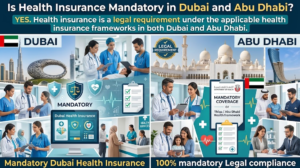
Health Insurance – Is it Compulsory in Dubai and Abu Dhabi?
Yes. Health insurance is compulsory by virtue of health insurance laws in Dubai and Abu Dhabi, respectively. In Dubai, employers are responsible for providing health insurance for their employees, while sponsors must arrange coverage for eligible resident dependents.
There is also a compulsory health insurance system in Abu Dhabi. Employers as well as sponsors are supposed to provide coverage to employees and eligible family members. Additionally, since 1 January 2025, health insurance became a condition for issuing/renewing residence visas of employees in the private sector and domestic workers in the extended compulsory insurance system of the UAE. For a comprehensive breakdown of national regulations, read our UAE Rules and Laws 2026: Essential Guide for Residents, Visitors & Businesses.
Hence, by 2026, residents must be aware that health insurance cannot be considered an option because of employers’ silence on the matter.
Dubai Health Insurance: How Does It Work?
However, regulations of health insurance in Dubai are different from regulations of the other regions in the country. According to the Dubai Health Law, health insurance is mandatory in Dubai.
Employers have to provide health insurance coverage to the employees according to the Dubai Health Law.
If employees are employed in the private sector, the employers arrange health insurance for the employees. The employees have to make sure that they know their health insurance by checking their health insurance card and the health insurance policy schedule.
Who Pays for Health Insurance in Dubai?
It should be noted that from the point of view of an employee, it is the employer who provides health insurance.
It means that it does not mean that the whole family would be insured by the employer.
Thus, if the person sponsors his family members, separate health insurance may be required.
Dubai Essential Benefits Plan
Dubai’s Essential Benefits Plan is designed to provide compliant basic medical insurance for eligible categories of workers.
However, basic insurance should not be confused with comprehensive private medical insurance.
A basic plan may have:
- A more restricted provider network
- Lower annual coverage limits
- Co-payments
- Specific exclusions
- Limited access to premium hospitals
- Defined outpatient and inpatient benefits
Thus, individuals who need to have access to more hospitals or gain extra benefits should think about getting a better plan.
Abu Dhabi Health Insurance: How Does It Work?
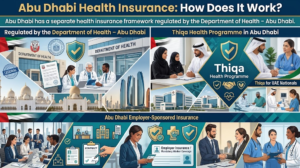
The health insurance scheme in Abu Dhabi is different from that of Dubai and is governed by the Department of Health – Abu Dhabi. Expatriate employees typically purchase health insurance through their respective employers, whereas sponsors have responsibilities pertaining to eligible dependents. In Abu Dhabi, there are also government-subsidized schemes for eligible UAE nationals.
Thiqa Health Scheme in Abu Dhabi
Thiqa is a government health insurance scheme for eligible UAE nationals and some other eligible categories. It offers access to healthcare facilities through the insurance scheme of the program. Nevertheless, the eligibility criteria are those laid down by the respective government authorities. Therefore, one cannot presume that all citizens living in Abu Dhabi are eligible for the Thiqa scheme.
Health Insurance in Abu Dhabi Arranged by the Employer
For private sector workers, the insurance is arranged by the employer. Depending on the selected type of insurance, benefits, provider network, and cost sharing may vary. That is why two employees can work in different firms in the same area and enjoy different healthcare benefits.
Difference Between Dubai and Abu Dhabi Health Insurance – Biggest Regulatory One
It would be wrong to say that the major difference is that one emirate has mandatory health insurance and the other does not. A mandatory system exists in both cases. The difference lies in the system of regulation and administration. Dubai follows the rules of its Dubai Health Insurance system, while Abu Dhabi has its own Department of Health – Abu Dhabi. Consequently, the insurance policies should comply with the relevant emirate regulations. For broader insights into federal mandates, plan types, and choosing coverage across the Emirates, check our UAE Health Insurance Guide 2026: Rules, Costs, Coverage & How to Choose the Right Plan.
This is particularly important for people who:
- Move between Dubai and Abu Dhabi
- Work in one emirate and live in another
- Change employers
- Sponsor family members
- Buy an individual policy
- Want treatment outside their home emirate
Make sure that the insurance policy that you have covers you throughout the UAE rather than taking it for granted that the insurance card gives you all access.
Dubai vs Abu Dhabi Health Insurance Cost in 2026
There is no single fixed price for health insurance in either emirate. Premiums depend on factors such as:
- Age
- Medical history and underwriting
- Coverage level
- Annual benefit limit
- Hospital network
- Outpatient benefits
- Maternity coverage
- Dental and optical benefits
- Deductible
- Co-payment
- Geographic coverage
- Number of insured family members
Considering 2026, the costs of an individual semi-comprehensive plan may fall in the following range: AED 1,300 to AED 6,600 per year for Dubai and AED 1,300 to AED 8,600 for Abu Dhabi. The quotes for comprehensive plans are generally provided as follows: Dubai – AED 3,000–12,000; Abu Dhabi – AED 2,500–11,000.
These are market estimates rather than government-set prices. Actual quotations can be considerably different depending on the applicant and policy.
Indicative Health Insurance Prices in 2026
| Plan Type | Dubai | Abu Dhabi |
| Basic/compliant cover | Varies by eligibility and policy | Varies by eligibility and policy |
| Semi-comprehensive | Approx. AED 1,300–6,600/year | Approx. AED 1,300–8,600/year |
| Comprehensive | Approx. AED 3,000–12,000/year | Approx. AED 2,500–11,000/year |
| Family cover for 4 | Approx. AED 6,200–28,000/year | Approx. AED 8,500–25,000/year |
These rates are important to planning a budget but must not be taken as definitive quotes. For instance, the quote for a young, single executive can be quite dissimilar from that of a family with children and maternity cover and a premium hospital plan.
What Is the AED 320 Basic Health Insurance Plan?
One important 2026 development is the expanded mandatory health insurance arrangement for private-sector employees and domestic workers. The UAE Government states that the basic package costs AED 320 per year under the applicable federal scheme. The policy is designed for eligible workers aged 1–64, with additional medical-disclosure requirements for people above 64.
The basic package includes defined co-payments and a specified healthcare network. For inpatient treatment, the insured generally has a 20% co-payment, subject to stated limits. Outpatient treatment has a 25% co-payment, while medication has a 30% co-payment subject to the applicable annual limit.
However, this AED 320 figure should not be confused with the price of every health insurance policy in Dubai or Abu Dhabi. A comprehensive private policy can cost several thousand dirhams per year because it may provide higher limits, broader networks, and additional benefits.
Dubai vs Abu Dhabi: Coverage and Hospital Networks
The provider network is one of the most important differences to examine when comparing insurance plans. A policy can appear inexpensive until you discover that your preferred hospital or clinic is outside the network.
Dubai Insurance Networks
Dubai offers a large selection of hospitals, clinics and medical centres. Depending on the policy, you may receive access to:
- General practitioner clinics
- Specialist centres
- Private hospitals
- Diagnostic laboratories
- Pharmacies
- Maternity hospitals
- Dental providers
- Optical providers
Premium policies generally provide access to broader networks. If you are reviewing network options in Dubai, consult our detailed directory of the Best Hospitals in Dubai, Your Ultimate Healthcare Guide.
Abu Dhabi Insurance Networks
Abu Dhabi also has a large healthcare network covering public and private providers. Depending on your insurance policy, coverage may include:
- Hospitals
- Clinics
- Specialist consultations
- Diagnostic centres
- Pharmacies
- Maternity services
- Emergency treatment
- Dental and optical services
However, network access is policy-specific. Therefore, before purchasing insurance, check whether the hospitals and clinics you actually use are included. For medical consultations and specialist care, explore our guide on finding the Best Doctors in Dubai (2026): Complete Guide to Specialists, Clinics & Healthcare.
Employer Health Insurance: Dubai vs Abu Dhabi
Employer-sponsored insurance is particularly important for employees.
In Dubai
Employers are required to provide health insurance for their employees. However, employers do not necessarily have to provide the same premium benefits that an employee might purchase privately.
For example, a company policy could cover:
- GP consultations
- Hospitalisation
- Emergency treatment
- Prescription medicines
while offering only a restricted network.
An employee can sometimes purchase additional private coverage if the employer plan does not meet personal preferences.
In Abu Dhabi
The employer is responsible as well for providing health insurance for their workers. Moreover, the health insurance scheme in Abu Dhabi has special rules related to family coverage and sponsorship. Thus, the employees need to consider if their health insurance covers not only themselves but also their eligible dependents.
Family Health Insurance: Dubai vs Abu Dhabi
Family coverage is another area where residents need to pay close attention. In Dubai, sponsors are responsible for obtaining insurance for their resident dependents. In Abu Dhabi, employers and sponsors have responsibilities for eligible family members under the applicable rules. The exact premium depends on:
- Number of family members
- Ages
- Coverage level
- Maternity requirements
- Hospital network
- Annual limits
- Pre-existing conditions
- Deductibles and co-payments
A family policy can therefore cost substantially more than an individual policy.
What Should Families Check?
Before buying family insurance, check whether the plan includes:
- Children
- Spouse
- Maternity
- Newborn care
- Paediatric consultations
- Emergency treatment
- Prescription medicines
- Specialist consultations
- Dental care
- Optical benefits
Most importantly, verify the waiting periods and exclusions for maternity and pre-existing conditions.
Maternity Insurance in Dubai vs Abu Dhabi
Maternity coverage is usually more expensive than basic medical coverage because pregnancy and childbirth can involve substantial healthcare costs. Depending on the policy, maternity benefits may include:
- Antenatal consultations
- Ultrasound scans
- Laboratory tests
- Normal delivery
- Caesarean delivery
- Complications
- Newborn care
However, benefits differ considerably between policies. Other policies require maternity waiting periods as well. This means that buying insurance when pregnancy is under way will not bring the same results as buying the proper insurance in advance. Make sure you know about the maternity limit, waiting period, co-payment, and hospital network before choosing the policy.
Pre-Existing Conditions and Chronic Illnesses
For persons having diabetes, hypertension, asthma, or any kind of other illness that is an ongoing problem, it would be wise for them to focus on the policy wording. Standard policies and comprehensive policies may differ in the way they deal with pre-existing conditions.
There might be cases where certain plans offer cover for these kinds of illnesses within some conditions and limitations. In such a scenario, it is essential for the applicants to be accurate in their medical disclosure when applying for insurance.
Co-Payment and Deductibles: What Is the Difference?
These two terms are often confused.
Co-Payment
Co-payment is where you will make payments of either a percentage or a fixed amount of the cost of medical expenses, whereas the rest will be covered by the insurer. For instance, in the case of a 20 percent co-payment, you will pay AED 20 of an eligible AED 100 bill.
Deductible
Deductible refers to the amount that one is required to pay before the insurer begins paying the qualifying costs according to the specific coverage. As an example, if a certain policy has an AED 500 deductible for a specific benefit, the first AED 500 for eligible costs may be paid by the insured person.
A health plan that has high cost sharing could have low premiums but the patient needs to think about out-of-pocket payment in case of such a plan.
Dubai vs Abu Dhabi: Government Health Programmes
Both emirates have government healthcare programmes, but they are not identical.
Dubai Enaya
Enaya is a Dubai Government healthcare benefits scheme covering eligible Dubai citizens and Dubai Government employees. Its eligibility rules are different from private expatriate health insurance.
Abu Dhabi Thiqa
Thiqa provides comprehensive health coverage to eligible UAE nationals and certain qualifying categories. This is done through an existing network of providers, which means that the citizens of UAE need to verify if they qualify for any programs offered by the government before buying health insurance on a private basis.
Does Dubai Health Insurance Work in Abu Dhabi?
It may be, but that will depend on the insurance program. There are some that cover the entire UAE, while there are those that are geographically limited. If you are living in Dubai and visit Abu Dhabi often, find out:
- Abu Dhabi hospitals included in your network
- Emergency coverage
- Planned treatment outside Dubai
- Direct billing availability
- Reimbursement rules
- Specialist access
- Prior authorisation requirements
In addition, a policy from Abu Dhabi may also offer care in Dubai, provided that Dubai-based service providers are part of the policy network. NEVER assume that the services covered in your policy are limited to the emirate on your insurance card.
Can Abu Dhabi Health Insurance Be Used in Dubai?
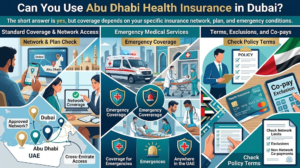
Yes, though that would depend on whether the insurance policy offers proper cover and the facility is in the approved network. Emergency cases are usually handled separately from non-emergency ones.
For non-emergencies, you will have to go to the network provider or get prior approval. So, for instance, if you travel frequently from Abu Dhabi to Dubai, you will find it better to have a policy covering the whole of the UAE.
Dubai Vs Abu Dhabi Health Insurance for Expats
As an expat, it’s not always a question of whether health insurance is required. The point is to understand what you are getting under this policy.
An expat should compare:
- Annual premium
- Annual coverage limit
- Hospital network
- GP access
- Specialist consultations
- Prescription medicines
- Maternity benefits
- Dental and optical coverage
- Emergency care
- Pre-existing conditions
- Co-payments
- Deductibles
- Geographical coverage
For example, a low-cost policy may satisfy mandatory insurance requirements but provide a smaller network than a premium plan. Consequently, the cheapest policy may not necessarily be the most suitable policy for someone who regularly needs specialist or hospital care. If you are planning a move or evaluating overall living costs in the UAE, see our Dubai Lifestyle Guide 2026: Everything You Need to Know Before Moving to Dubai.
What Is Usually Covered by UAE Health Insurance?
Depending on the policy, health insurance may cover:
Outpatient Treatment
- GP consultations
- Specialist consultations
- Diagnostic tests
- Laboratory tests
- Prescribed medicines
Inpatient Treatment
- Hospital admission
- Surgery
- Room charges
- Doctor and surgeon fees
- Emergency hospital treatment
Additional Benefits
Some comprehensive policies can also include:
- Maternity
- Dental
- Optical
- Physiotherapy
- Mental health benefits
- Preventive healthcare
- International emergency coverage
Nevertheless, benefits vary between insurers and plans.
What Is Usually Not Covered?

Common exclusions or limitations can include:
- Cosmetic procedures
- Experimental treatment
- Certain elective procedures
- Treatment outside the approved network
- Non-prescribed medicines
- Certain pre-existing conditions
- Services exceeding policy limits
- Treatment excluded under the policy schedule
The exact exclusions are more important than the headline premium. Therefore, read the policy schedule and terms before purchasing.
How to Choose Health Insurance in Dubai or Abu Dhabi
Rather than choosing a policy based only on price, compare the following factors.
1. Check Your Visa and Employment Status
See if your employer offers insurance and if your dependants require their own insurance.
2. Check the Network of Hospitals
Look up the hospitals and clinics you will be interested in using.
3. Compare Annual Limits
Insurance that has high annual limits will give you better coverage during big medical emergencies.
4. Compare the Co-payments
A low premium can come with higher out-of-pocket costs.
5. Verify Maternity Coverages
If you plan to have children, then you should look at maternity restrictions and waiting periods prior to buying.
6. Pre-Existing Conditions Policies
Make sure that you know how your pre-existing health conditions will be covered.
7. Geographical Coverages
If you travel between Dubai and Abu Dhabi, make sure that the coverages in UAE are available under your plan.
8. Know the Claims Process
Find out if the insurance company offers direct billing or needs reimbursement.
Dubai vs Abu Dhabi Health Insurance: Which Factors Matter Most?
The one-size-fits-all policy does not apply to everyone living in Dubai. A single employee could have different needs than a whole family, or a family may need more extensive coverage than an employee. The needs of people who travel regularly across the emirates can vary significantly compared to those staying at home in one place.
The healthcare needs of someone requiring constant treatment can differ from the requirements of someone healthy. In simple words, the needs and preferences of patients are the determining factor.
Final Thoughts
However, when talking about health insurance in Dubai vs Abu Dhabi, the difference is more about the regulation, but not about the necessity of insurance itself. Each emirate has its own obligatory health insurance policy; Dubai has its own program, and Abu Dhabi follows the Department of Health – Abu Dhabi. There are various government programs, insurance policies, and networks of hospitals in both emirates.
In case you are a resident, what matters most is that you should pay attention not only to the annual cost, but also to such issues as hospital network, limitations, co-payments, exclusions, maternity services, drug coverage, and geographical coverage. As the last point, if you work in one emirate and get healthcare services in another on a regular basis, make sure that you have cross-emirate insurance. It will save you from medical expenses in the future.
Frequently Asked Questions
Is there any requirement for health insurance in Dubai in 2026?
Yes. Under the Dubai health insurance system, health insurance is mandatory, where the responsibility lies with the employer for its employees and sponsors for their eligible family members.
Is there any requirement for health insurance in Abu Dhabi in 2026?
Yes. The health insurance system in Abu Dhabi is mandatory for the relevant residents where the employers and sponsors bear responsibility for their employees’ and families’ health insurance.
Is health insurance in Dubai more expensive than Abu Dhabi?
No. It varies based on age, type, company, and level of insurance coverage.
How much is the cost of basic health insurance in the UAE?
According to the basic mandatory health insurance plan of the federal government for eligible private sector workers and domestic workers, the yearly cost of health insurance is AED 320.
Will my health insurance cover my dependents in Dubai?
No. In Dubai, the sponsor is supposed to obtain insurance for any resident dependents he or she has. The employer can choose to include your dependents in his group health insurance.
Can my Dubai insurance be used in Abu Dhabi?
Your health insurance may be used if the providers in Abu Dhabi are included in the network.
Can my Abu Dhabi insurance be used in Dubai?
It may work in Dubai if it includes the providers there.
Does health insurance cover dental?
It does not cover all dental treatments. It may cover some dental treatments, but only those that may be specified in your health insurance contract.
Does health insurance cover maternity?
It covers maternity in most cases, but in other situations, it covers limited maternity care.
What is the difference between basic and comprehensive health insurance?
Basic health insurance is supposed to provide the required minimum level of health insurance according to the regulation. Comprehensive health insurance is supposed to provide better networks and more benefits.

