

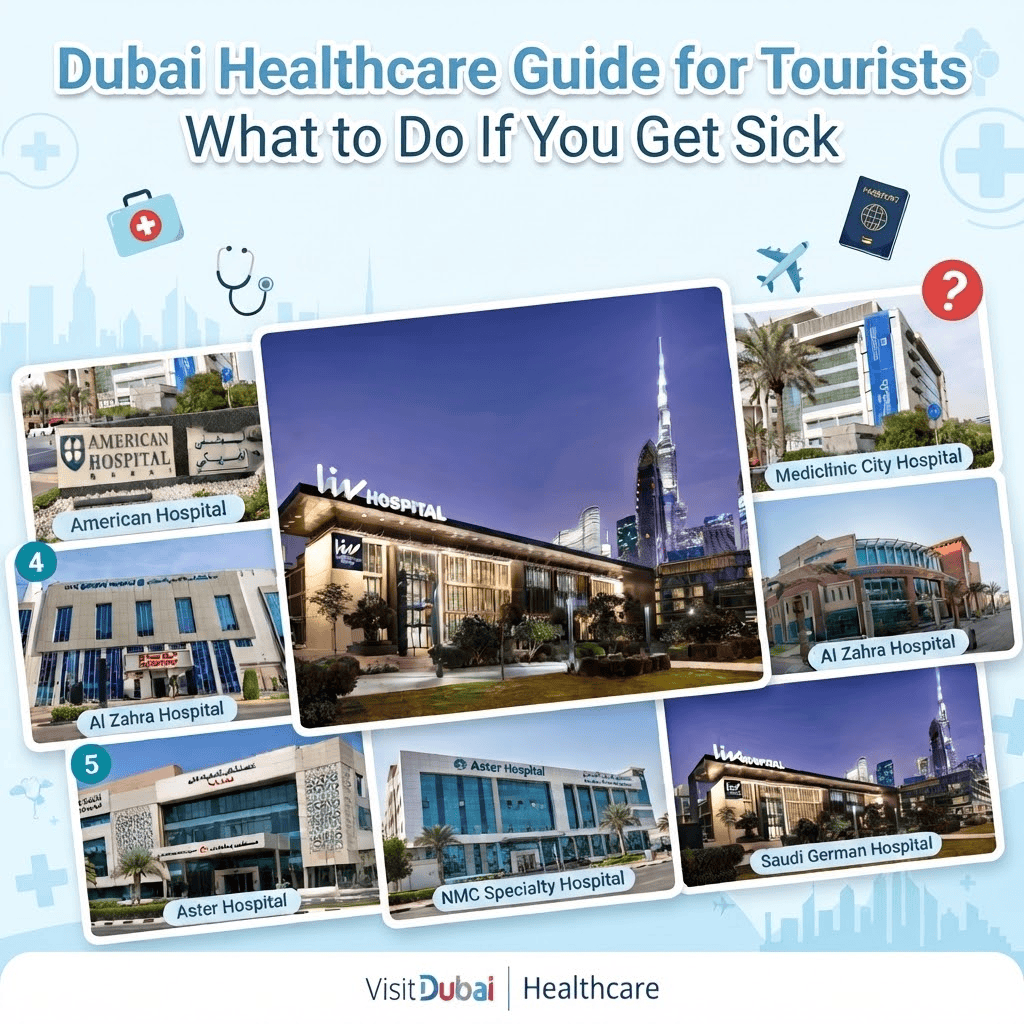
Dubai is renowned for its interesting locations such as attractions, luxury hotels, shopping malls, beaches, and desert trips. Nonetheless, any trip can turn out not to be fun because of fever, stomach disorders, allergic reactions, trauma, and other diseases. Luckily, Dubai has a highly developed healthcare system that encompasses hospitals, clinics, pharmacies, emergency rooms, and other medical establishments.
In case you fall sick during your stay in Dubai, you should not worry at all. Depending on the severity of the problem, you can visit a pharmacy, have an appointment with a general practitioner, go to the hospital, and even summon an ambulance. Furthermore, some of the medical establishments have English-speaking staff and see foreigners often enough. The current Dubai healthcare guide for tourists will give you information about how to act in case of illness, how to locate the healthcare facility, how much common medical procedures cost, how the emergency service works, and what documents you need to have with you.
Is Healthcare Available to Tourists in Dubai?
Yes. Tourists can avail of medical care services at healthcare centers in Dubai. Tourists can avail of public or private health care centers, but the costs will vary according to the center and the terms of your travel insurance. The UAE government recommends that all people requiring health care carry some sort of identification document, such as a passport. Therefore, it would be convenient for you to have your passport handy.
Health Care Centers in Dubai are provided by Dubai Health and by various hospital groups and clinics which are available in the private sector. The list of hospitals that form part of Dubai Health’s hospital network includes Dubai Hospital, Rashid Hospital, Hatta Hospital, Jebel Ali Hospital, Al Jalila Children’s Hospital, and Latifa Hospital.
What Should You Do If You Get Sick in Dubai?
It depends on the severity of your symptoms.
When Your Symptoms Are Minor
In case you get sick from the flu, fever, a minor stomach ache, or other illnesses, it is necessary for you to visit the pharmacy or GP. For instance, the GP can evaluate your symptoms, provide you with some suggestions, prescribe some medication, and perform some further examinations.
When You Have To See A Doctor Because Of Severe Symptoms
But if your symptoms remain the same, are severe, and make your trip to Dubai difficult, you must visit a doctor at the hospital or the clinic, not try to treat yourself. This will be needed in case you suffer from:
- Fever
- Vomiting/Diarrhoea
- Dehydration
- Ear/Throat Infection
- Stomach ache
- Cough/Breathing difficulties
- Allergies
- Serious injuries
- Infection
- Symptoms you are worried about
For a Medical Emergency
If the patient is at risk of death, call 998 to get an ambulance anywhere in the UAE. For critical situations, knowing the nearest 24/7 emergency hospitals in Dubai and urgent care protocols ensures you get immediate medical attention. One must not attempt to drive to the hospital in a life-threatening situation.

Dubai Emergency Numbers Tourists Should Know
Keep these numbers saved on your phone during your trip:
| Service | Emergency Number |
| Ambulance | 998 |
| Police | 999 |
| Civil Defence / Fire | 997 |
| Dubai Health customer support | 800 60 |
Emergency medical services in the UAE can be contacted on 998, while the emergency number for the police is 999. In case there is any need for an ambulance in an emergency situation, it is always good to mention the location. Giving details of your hotel, building, streets, or landmark would be beneficial.
What Hospitals Provide Emergency Services in Dubai?

There are many top-tier hospitals in Dubai providing emergency services. Dubai Health assures that all six of its public hospitals provide an emergency department, along with Al Barsha Health Center and Nad Al Hamar Health Center.
Important Dubai Health hospitals that provide emergency care are:
- Dubai Hospital – Deira
- Rashid Hospital – Umm Hurair
- Hatta Hospital – Hatta
- Jebel Ali Hospital – Dubai Industrial City
- Al Jalila Children’s Hospital – Al Jaddaf
- Latifa Hospital – Al Jaddaf
The emergency medicine department of Dubai Health provides emergency and urgent care throughout the day with critical care facilities in Dubai Hospital, Rashid Hospital, Hatta Hospital and Jebel Ali Hospital.
Dubai Hospital
Dubai Hospital is located on Al Khaleej Street, Deira, and it provides 24-hour emergency services. It would be helpful for visitors to Deira, Bur Dubai, Dubai Creek, and its surroundings.
Rashid Hospital
There is another hospital that provides emergency services in Dubai, and it is Rashid Hospital. It is located in Umm Hurair.
Hatta Hospital
If someone visits Hatta and finds himself in an emergency, then he can find round-the-clock emergency service at Hatta Hospital.
Costs for Healthcare for Visitors to Dubai
The cost of healthcare differs substantially depending on the clinic or hospital, doctors, treatment, tests done, and whether or not you have health insurance.
Based on average costs for the market in 2026, consultation at a private general practitioner (GP) clinic may cost between AED 150-AED 500, while more premium clinics may even charge higher. Specialist consultations are usually much more expensive.
Typical cash price ranges include:
| Medical Service | Approximate Cost |
| GP consultation | AED 150–500+ |
| Specialist consultation | AED 300–1,000+ |
| Basic blood tests | AED 150–600+ |
| X-ray | AED 150–500+ |
| Ultrasound | AED 400–800+ |
| CT scan | AED 800–2,000+ |
| MRI | AED 900–3,500+ |
| Prescription medicines | Varies considerably |
These are approximate ranges instead of fixed prices in Dubai. Final price depends upon the health service provider, doctors, tests performed, medication, treatment, and insurance coverage.
For instance, according to one of the current pricing guides for healthcare in Dubai, consultations by GPs are between AED 150-500, while another guide claims that GP consultations without insurance are mostly between AED 200-400. Hence, if your situation does not involve any emergency, then you should inquire about the approximate consultation or treatment cost from the clinic.
Travel Insurance and Medical Treatment in Dubai
Having adequate travel coverage or reviewing the standard UAE health insurance rules is essential in case of sudden illnesses or injuries that occur while you travel.
Make sure before traveling that your plan covers:
- Emergency medical treatment
- Hospitalization
- Doctor’s visits
- Prescription drugs
- Ambulance services
- Dental emergency
- Evacuation
- Treatment of preexisting conditions, if any
- Trip cancellation due to illness
But different plans provide different coverages. Hence, never assume that every medical cost will be covered. Save your insurance policy number and emergency number along with a copy of your policy in your mobile.
What If You Don’t Have Travel Insurance?
Medical assistance can be accessed. But then again, it might be necessary to pay the health care practitioner personally. According to Dubai Health, their emergency department does not provide any free service but rather is dependent on the patient’s health insurance cover. This means that individuals who visit Dubai without health insurance need to know how much they will pay for their visits.
Is It Possible to Go to the Dubai Clinics Without Having Insurance?
Certainly. Tourists can usually get their health services by paying for themselves. Visiting a private clinic to consult with some of the best doctors in Dubai could be better suited for treating minor ailments without the long wait times of an ER. Some examples of cases that tourists usually visit clinics for include:
- Fever and influenza
- Coughing and sore throat
- Problems with stomach
- Skin issues
- Allergies
- Minor injuries
- Prescription consultations
- Follow-ups
- Medical advices
The cost of a consultation by a private GP could usually be about AED 150-500.

What Papers Should Tourists Have When Getting Medical Care?
If you visit a hospital, make sure that you have the following:
- Passport
- Visa or information on entry, if any
- Travel insurance
- Phone number of the insurance company
- Information on previous illnesses, if applicable
- Medication list
- Allergies
- Emergency contacts
According to the UAE government, hospitals can ask for the Emirates ID card or passport for health care purposes. Thus, having a passport becomes essential for tourists.
Is It Possible to Purchase Medicines in Pharmacies of Dubai?
There are pharmacies in residential areas, shopping zones, hospitals, and large tourist areas in Dubai. The pharmacies will provide advice about minor diseases and will be able to sell medicines without a doctor’s prescription by the doctor.
However, there are medicines that cannot be purchased from the pharmacist without a prescription. Prescription medicines include medications such as antibiotics. Dubai Health Authority has classified medicines into prescription medicines, over-the-counter, and general sales medicines. It is advisable not to assume that all the medicines bought from the pharmacy back home can be bought in the same manner in Dubai.
Bring with You Your Regular Medication
In case you use medicines on a regular basis, then you must take your medicines along with your prescription. You need to keep in mind those medicines which are classified as controlled, narcotic, or psychotropic medicines. There are certain requirements for some medicines by the authorities of the United Arab Emirates.
According to the Emirates Drug Establishment, individuals who use their prescribed medicines must travel with a prescription and reports.
What If You Get Heat Exhaustion in Dubai?

The climate of Dubai is quite hot, especially during summer. In case of symptoms like feeling dizzy, fainting, feeling excessively tired, nausea, and headache from heat, try to go somewhere cool or to air conditioning and drink some fluids if you can. However, confusion, loss of consciousness, severe weakness, and elevated body temperature are symptoms requiring immediate medical treatment. Measures you should take to prevent risks are as follows:
- Drink plenty of water.
- Do not stay outside for too long during the hottest times.
- Put on loose and light colored clothing.
- Use sunscreen.
- Stay in air-conditioned places.
- Do not drink excessive amounts of alcohol.
What If You Have Food Poisoning or Abdominal Issues in Dubai?
Individuals can suffer from abdominal issues while vacationing due to dietary variations, hot weather, dehydration, or foreign food intake. Individuals suffering from vomiting and diarrhea can attempt to consume adequate amounts of water and take some rest. The individual can take rehydration salts in case he/she is suffering from:
- Severe or chronic abdominal pain
- Bloody stools or vomits
- Dehydration
- Chronic vomiting
- High fever
- Confusion or abnormal weakness
- Symptoms that rapidly deteriorate
- Do not postpone visiting a doctor.
What Should You Do If You Have a Minor Injury?
For a simple cut, sprain, or burn, or such an injury, a pharmacy or clinic might be suitable. However, for injuries with profuse bleeding, suspected fracture, unbearable pain, head injury, unconsciousness, and difficulty in moving a body part, emergency medical help should be sought. In case of a major injury, calling 998 is advised instead of travelling alone.
What If You Need a Doctor at Your Hotel?
There are some private healthcare providers in Dubai that provide services such as doctor-on-call or at-home visit services. These may prove helpful in cases where you are unable to go out because of ill health but don’t need an ambulance.
Prices differ significantly. Current prices for 2026 private healthcare providers include home visits during the daytime starting from hundreds of dirhams and above, depending on the provider and service. Ask yourself before making any appointment:
- Is the doctor qualified?
- What is the cost of consultation?
- Do medicines come with the service?
- Are laboratory tests charged separately?
- Is the travel insurance accepted by the provider?
- Is there an additional fee for the night or weekends?
- Be sure that doctor-on-call is not an ambulance substitute in emergencies.
How Does Emergency Treatment Work in Dubai?
Once you get to the emergency department, your situation is evaluated based on the urgency of the case. Therefore, you can be seen and treated before someone who has a mild condition, especially when the latter arrived much earlier than you.
Make sure you bring along your passport and insurance information if these are easily accessible. However, do not hesitate to get immediate treatment even if you lack some documentation. According to Dubai Health, the emergency departments work 24 hours a day and cater to different kinds of emergencies.
What Languages Are Spoken in Dubai Healthcare Facilities?
Dubai is one of the most international cities, and the hospitals provide treatment to people belonging to several nations.
English is commonly used in the medical field in Dubai, but there are many hospitals that also hire employees who know how to speak many other languages, including Arabic. But in case you encounter any issue because of the language barrier, you should always have a note in your phone listing the following:
- Your Symptoms
- Medical Conditions
- Allergies
- Medications
- Contact Information
- Insurance Details
Healthcare Tips for Tourists Visiting Dubai
Preparations are simple to make to be ready to handle any sicknesses easily.
Save Your Emergency Contact Numbers
Keep 998 for an ambulance, 999 for the police, and your emergency insurance help line number before leaving the hotel.
Keep Your Insurance Information Easily Accessible
Make a scan of your insurance information and keep the information in your email folder.
Keep Your Passport with You
The passport may be required when registering for your health care services.
Make a List of Your Medications
List the medications that you take regularly to get replacements whenever you need one.
Check Medications Regulations
In case you plan to bring regulated or prescription medication to Dubai, it would be better to check all the requirements before travelling.
Hydration
Dubai is hot, and walking around may cause dehydration.
Never Ignore Critical Symptoms
It might be possible that some mild illness may go away after a rest period, but it should always be diagnosed by professionals.
Healthcare for Children Visiting Dubai

Above all, one has to find the nearest hospital or clinic prior to sightseeing. In case someone is feeling slightly unwell, it is recommended that one consult a pediatrician or general practitioner. However, in case of trouble with breathing, fainting, dehydration, seizures, or any kind of injury, one should get urgent assistance from doctors.
There is the Al Jalila Children’s Hospital working within the health care services of Dubai, and it is situated in Al Jaddaf; in addition, there are also some private hospitals offering pediatric services. One needs to be ready to provide vaccination history, history of taking medicines, as well as information about allergies and insurance.
Dental emergencies for foreigners in Dubai
In some cases, tooth pain may ruin the whole holiday experience. One should not panic because there are lots of clinics providing dental care in Dubai. In order to book an appointment with a dentist, one needs to call the specific clinic and get information about prices and appointments. It is important to remember that in case of emergencies, one will have to pay additional money depending on the kind of procedure performed (an X-ray, tooth extraction, filling, root canal treatment, etc.). If you suffer from facial swelling, uncontrollable bleeding, dental injury or difficulties breathing, go to the emergency room first.
How Should You Prepare Before Traveling to Dubai?
A small amount of preparation before your trip can save you from a lot of stress. As part of your complete Dubai travel checklist, make sure you organize a digital healthcare folder that includes:
- Copy of your passport
- Details of travel insurance
- Ambulance contact number in the policy
- Prescriptions
- Medicine list
- Medical record
- Emergency contacts
- Address of hotel
- Moreover, make sure that you keep 998 in your phone book.
Quick Healthcare Checklist for Tourists
| Situation | What to Do |
| Mild cold or headache | Pharmacy or GP |
| Persistent illness | Visit a clinic |
| Minor injury | Clinic or urgent care |
| Severe symptoms | Hospital emergency department |
| Life-threatening emergency | Call 998 |
| Need regular medicine | Contact a licensed doctor/pharmacy |
| Need treatment without insurance | Ask for self-pay pricing |
| Insurance-covered treatment | Contact insurer and approved provider |
| Controlled medication | Check UAE requirements before travelling |
Final Thoughts
Illnesses are never timely; nonetheless, the healthcare system in Dubai offers many options to access medical help. First of all, it is vital to distinguish an illness from an emergency. Minor illnesses do not need to be seen by doctors; in these cases, pharmacies and clinics will suffice. In case of serious problems, an ambulance needs to be called via phone number 998. Moreover, it is necessary to buy proper insurance, carry a passport and health records everywhere, and consult UAE prescription laws regarding the transportation of medication. With this advice, one will be able to relax while enjoying his/her vacation in Dubai.
Frequently Asked Questions
Are there hospitals in Dubai that can cater to tourists?
Yes, hospitals are available for tourists in Dubai depending upon their requirements for visits to clinics, hospitals, pharmacies, or even the ER.
What is the number for ambulances in Dubai?
People can contact ambulances for emergencies in Dubai using the number 998 in the UAE.
Is there free emergency health care service for tourists in Dubai?
No, this may vary according to the situation. According to the Dubai Health Authority, it will not always be free and depends upon insurance, copayment, and exclusions.
Can people visit doctors without having travel insurance?
Yes, one can visit doctors even without having travel insurance.
What is the cost of a private consultation in Dubai?
The average cost of a consultation in Dubai is AED 150-500.
Are antibiotics available in Dubai without a prescription?
Antibiotics and other prescription drugs need a proper prescription from a qualified doctor.
Can I carry my usual medicines to Dubai?
Ordinary medicines can usually be brought for personal consumption, but there are special requirements for certain controlled medicines. Travellers should review the latest regulations of the UAE prior to their visit.
What documents do I need for treatment in a Dubai hospital?
Bring your passport, your travel insurance information, necessary medical history, information about your medications, allergy history, etc. The UAE Ministry of Health says that healthcare institutions will ask you for your Emirates ID or passport.
Is Dubai healthcare 24 hours a day?
Emergency services are provided 24/7 in Dubai Health Hospitals, such as Dubai Hospital, Rashid Hospital, Hatta Hospital, and Jebel Ali Hospital.

